Most people walk through the Palacios Nazaríes looking up at ceilings and down at tilework, and never register that the bands running along the walls at eye level are sentences. They're not decoration in the abstract sense — they're poems, Quranic verses, and one phrase repeated so often it functions as the dynasty's motto. Knowing roughly what you're looking at changes the visit from "pretty patterns" to something closer to reading a very slow, very patient piece of political theater.
The phrase that's everywhere
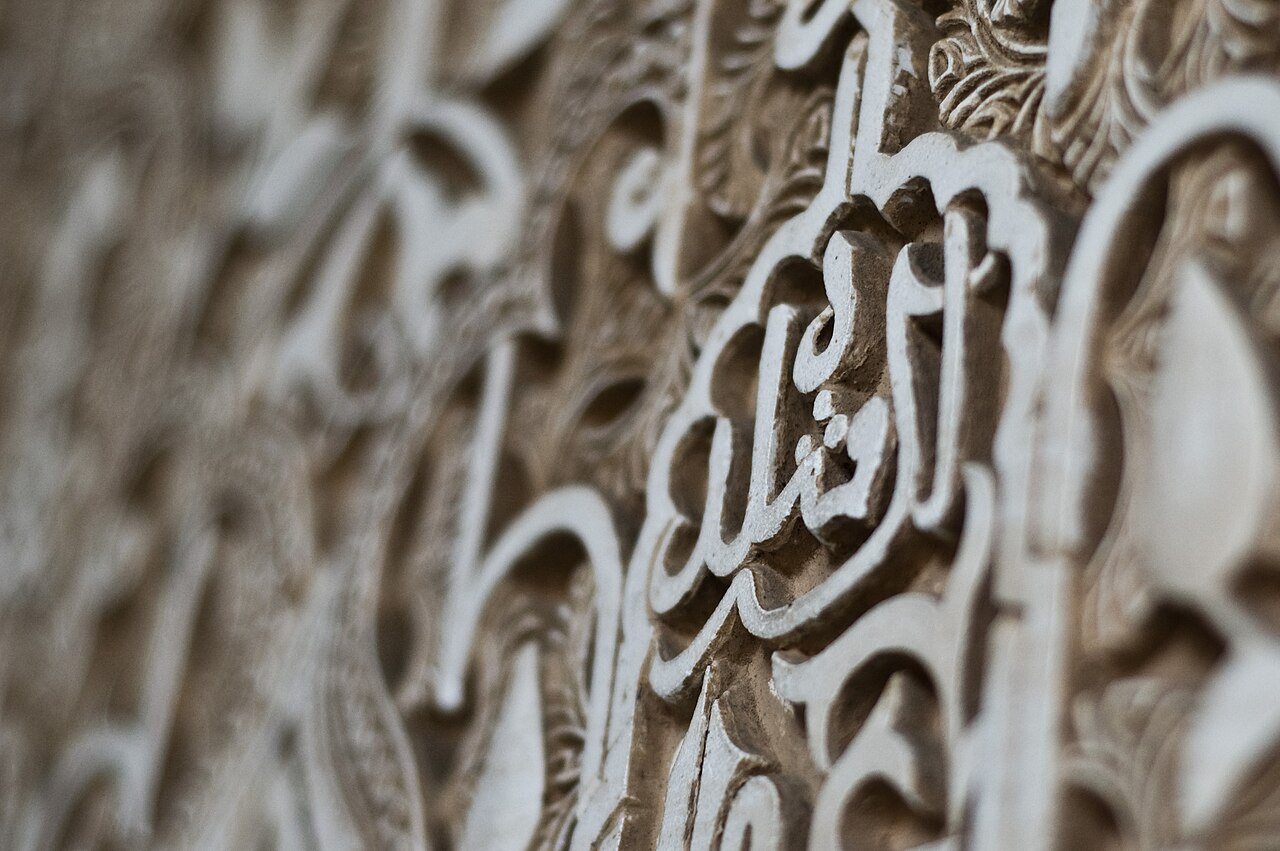
If you learn to recognize one string of Arabic script, make it wa la ghalib illa Allah — "there is no victor but God." It appears, by most scholarly accounts, more than any other inscription in the palace complex: on the walls of the Comares Palace, around the Patio de los Leones, threaded into the stucco of the Sala de los Abencerrajes. It was the personal motto of Muhammad I, the founder of the Nasrid dynasty, and his successors kept using it for two centuries.
The phrase does double duty. On one level it's pious formula, a standard Islamic acknowledgment that no human triumph is final or self-authored. On another, it's a piece of dynastic branding repeated at a scale that would embarrass a modern marketing department — a way of putting the ruler's name (or at least his adopted slogan) into the fabric of every room a visitor or ambassador might stand in. ⭐ Once you've spotted it in one room, you'll start seeing it everywhere, which is rather the point.
Poems written for specific rooms
The more striking inscriptions aren't formulaic — they're commissioned poetry, written by court poets specifically for the space they occupy, often describing the room itself. The most famous example rings the basin in the Patio de los Leones: verses by Ibn Zamrak, the vizier-poet of Muhammad V, describing the fountain and its twelve lions in the courtyard as if the stone itself were speaking, boasting about its own beauty and craftsmanship. It's an unusual literary conceit — architecture given a first-person voice — and it was clearly meant to be read on site, by people standing exactly where you'll stand.
Ibn Zamrak's poems turn up throughout the Nasrid Palaces, and other court poets contributed as well; the inscriptions in the Sala de las Dos Hermanas and the Mirador de Lindaraja carry similarly self-referential verse, describing gardens, water, and light in language that reads like a guidebook written for God rather than for tourists. The effect these poems were going for — and by most readings, still achieve — is a kind of doubling: the room describes itself while you're standing in it, so the architecture and the text confirm each other.
Quranic text and where it clusters
Alongside the poetry and the motto, you'll find passages from the Quran, generally concentrated in and around spaces with a devotional or symbolic function — door frames, mihrab-adjacent niches, thresholds. These inscriptions tend to be more static and formal than the poems: verses chosen for their appropriateness to a space of passage or prayer, rather than verses composed to order. The distinction matters for reading the walls: if the script feels descriptive and specific to the room's use, it's likely one of the court poems; if it feels more universal and formulaic, it's more likely Quranic or devotional text.
None of the three registers — the ruler's motto, the commissioned poetry, the sacred text — was meant to be casual wallpaper. Manuscripts and inscriptions were high-status objects in the Nasrid court, and putting a poem into carved stucco or tile was a way of making it permanent in a way that paper never could be. ⚠️ It's worth resisting the urge to read the Alhambra's decoration purely as pattern; a fair amount of what looks like abstract geometric interlace is, on closer inspection, calligraphy stretched and repeated until it stops reading like words and starts reading like texture. Guides and interpretive panels inside the palace point this out at a few key spots, and it's genuinely worth slowing down for.
Reading them without reading Arabic
You don't need Arabic to get something out of this. A few practical approaches:
- Look for repetition first. The eye catches patterns before it catches sentences, and the repeated diamond-and-swirl shapes of "wa la ghalib illa Allah" become recognizable within a few rooms.
- Pay attention to inscriptions placed at a readable height — roughly eye level or just above — versus those worked into ceiling muqarnas far overhead. The lower bands were meant to be read; the upper ones were more about overall visual density.
- The interpretive materials provided at the site (and audio guides, where used) will usually translate the more famous passages, including Ibn Zamrak's fountain poem, so you don't need to track this down beforehand.
- Photographs of the stucco bands are easy to take and easy to research later; if a particular inscription catches your eye, a photo lets you look up the translation once you're home rather than trying to absorb everything on the spot.
It's also worth remembering what happened to this script after 1492. The surrender terms agreed between the Catholic Monarchs and Boabdil guaranteed the Muslim population's religion, language, and property — guarantees that had unraveled within a decade, well before the mass expulsions and forced conversions that followed. The inscriptions themselves survived largely because later Christian occupants of the palace, including the household of Charles V, treated the Nasrid rooms as ceremonial curiosities worth preserving rather than replacing outright. The nearby Palace of Charles V, built directly alongside the Nasrid palaces, has no equivalent inscriptions at all — its walls speak in classical orders and Latin-inflected ornament, a deliberate contrast that's easy to miss unless you've just come from a room full of Arabic verse.
For context on who was writing these poems and why, the dynasty's own history is worth reading before or after your visit — see The Nasrids for the political backdrop. And if you're planning your time across the whole complex, the itineraries section has suggestions for pairing the palace rooms with the quieter corners of the Generalife, where a handful of the same inscriptions turn up in a much less crowded setting.
In pictures