The word "Alhambra" gets used loosely, as if it were a single building. It isn't. It's a walled hill with three distinct palace zones built at different times, for different purposes, by different rulers — and the ticketing system (a timed slot for one part of it) tends to obscure the fact that these are three separate arguments about what a palace is for. Read them in order and the site makes a kind of sense that it doesn't if you wander in expecting one big castle.
Start with the fortress, because it came first
The Alcazaba is the oldest working part of the hill, a military fortress with roots going back before the Nasrids, though what stands now is largely Nasrid-era rebuilding. There's no throne room here, no carved plasterwork — just thick walls, a keep (the Torre de la Vela), and a view. Climb the tower and you get the clearest orientation lesson on the entire hill: the Albaicín laid out across the valley, the Sierra Nevada behind you, and the Darro cutting the gorge below. This is public power in its plainest form — walls and watchtowers, built to be seen from the city and to see the city back.
It's worth doing the Alcazaba early precisely because it has none of the intimacy of what comes later. You're meant to read it from the outside in: this is a place that announces control before it offers anything softer.
The Palacios Nazaríes: the argument gets private
Move from the Alcazaba to the Palacios Nazaríes and the register changes completely. These are the royal residential and ceremonial palaces built mainly under Yusuf I and Muhammad V in the fourteenth century, and they're organized as a sequence of increasingly private courtyards rather than a single hall. The Mexuar, where the sultan heard petitions and administered justice, is the most public room in the complex — still formal, still somewhat exposed. Pass through it and you reach the Comares Palace, built around a long reflecting pool, culminating in the Salón de Comares, the throne room, where the sultan received ambassadors under a ceiling meant to represent the seven heavens of Islamic cosmology.
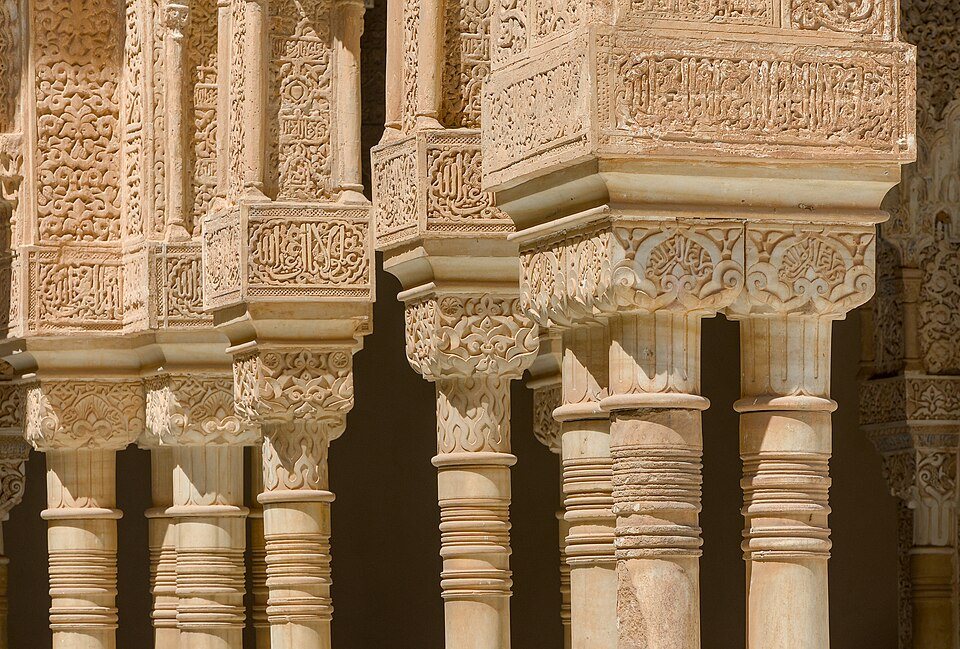
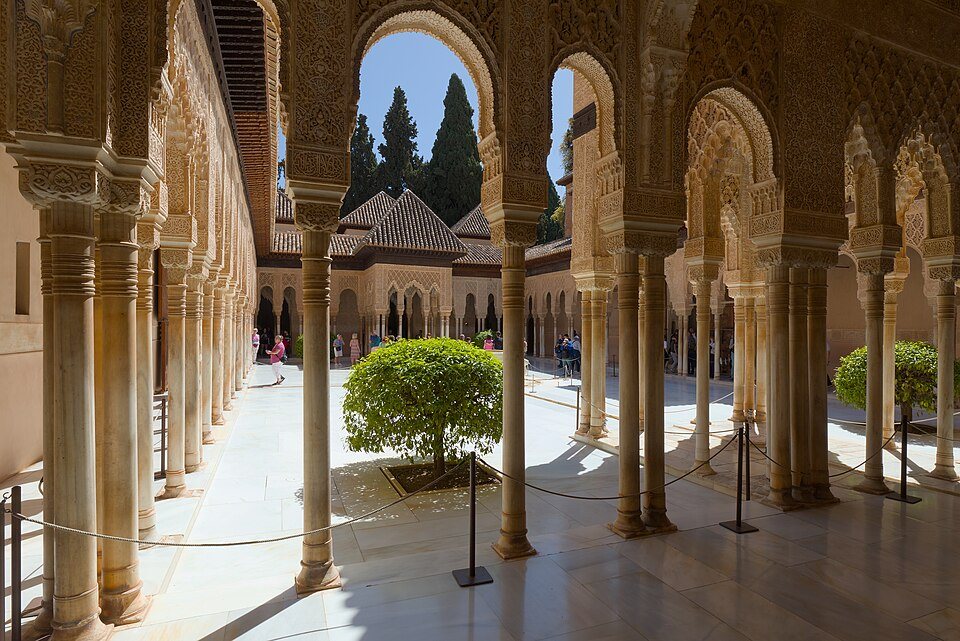
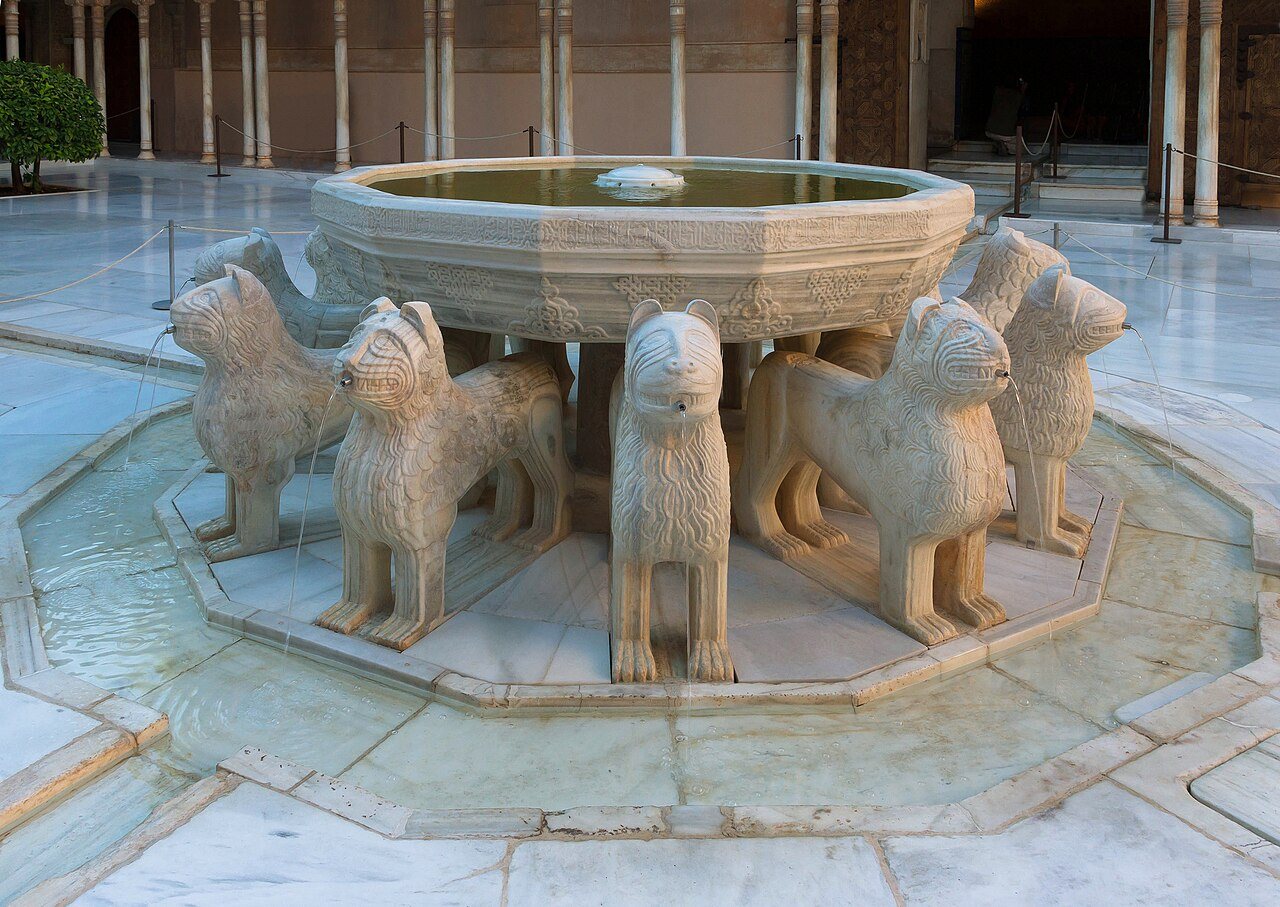
Keep going and you arrive at the Patio de los Leones, the most private zone of all — the sultan's family quarters, built around the famous fountain with its twelve stone lions. The carving here is denser, the scale is smaller, the light is filtered through arcades rather than falling across an open pool. That's not decoration for its own sake; it's the architecture tracking a real social gradient, from the business of governing to the life of a household. ⭐ If you only remember one thing about the order of these rooms, remember that the water changes character as you go — the long still pool at Comares is about reflection and formality, the fountain at the Lions is about a private, domestic sound.
Charles V's palace, the stark Renaissance building squeezed in alongside the Nasrid rooms, is worth a look precisely because it breaks the pattern. The Palacio de Carlos V is a perfect circle inside a square, built after 1526 by the Christian monarchy that had taken the city, and it reads as a deliberate architectural statement of a new order laid directly on top of the old one. It has nothing to do with the sequence of privacy that structures the Nasrid palaces — it's a different building grammar entirely, and its presence on the hill is itself a fact worth sitting with, not just a curiosity.
The Generalife: not a palace so much as an idea of relief
The Generalife sits on a separate rise, connected to the main hill by a walkway, and it was the sultans' summer retreat and working estate — orchards, water channels, gardens designed for escape rather than governance. The Patio de la Acequia, with its long central water channel and cross-jets, is the postcard image, but the more telling detail is how much of the Generalife is about agriculture and irrigation rather than display. The Nasrids built an elaborate water system to feed both the ornamental gardens and productive orchards, and that combination — beauty and utility running through the same channels — says something about how they thought about a summer residence at all.
If the Alcazaba is public power and the Palacios Nazaríes trace a path from public to private, the Generalife is the release valve at the end of that path: the place you go when the audience is finally over.
Practical notes on reading it in order
The site's own layout doesn't force you through this sequence — the modern entrance and the placement of the visitor route mean people often see the Generalife first or last almost at random, and the timed entry system for the Palacios Nazaríes can scramble the order further if you don't plan around it. But if you have any choice in your route, doing Alcazaba, then Palacios Nazaríes, then Generalife lets the architecture do the explaining. You feel the shift from wall to reception room to family courtyard to garden, rather than encountering the domestic quarters as a random detour.
- ⚠️ The Palacios Nazaríes require a specific timed entry printed on your ticket, and arriving even a few minutes past your slot can mean being turned away — check the mechanism on the official booking system before you plan the rest of your day.
- ⭐ Early morning light in the Comares pool and late afternoon light in the Patio de los Leones are different enough that it's worth timing your visit to your priorities, not just your ticket slot.
- The walk between the main Alhambra complex and the Generalife takes longer than most visitors budget for, especially in summer heat — build in real time, not a few spare minutes.
For where this all sits in a longer Granada visit, see the Alhambra overview and the broader itineraries section, and for the historical context of who built what and why, the Nasrids is the place to start.
In pictures