Everyone arrives at the Court of the Lions with the same picture in their head, usually from a textbook or a tile in a gift shop: a narrow courtyard, a forest of slim marble columns, a fountain held up by twelve stone lions. The real thing is smaller than people expect, and stranger. It is also, almost always, the most crowded single space inside the Palacios Nazaríes, so it rewards a bit of advance thinking about when and how you see it.
What you're actually looking at
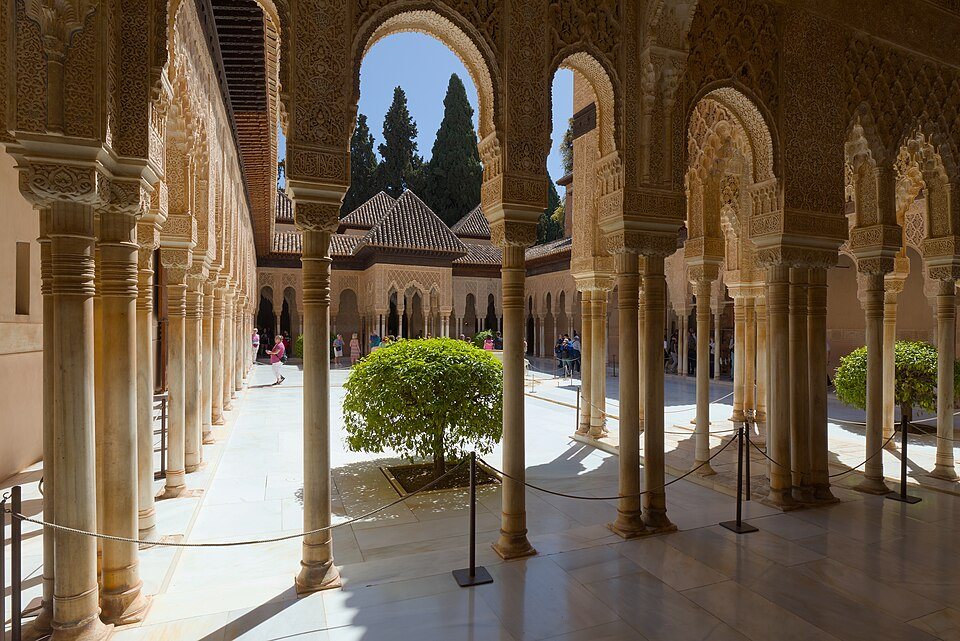
The Patio de los Leones sits at the heart of what was the private residence of the Nasrid sultans, the innermost and most restricted part of the Alhambra complex. It was built under Muhammad V in the second half of the 14th century, and its design is organized around a basic idea of Islamic garden architecture: a courtyard divided into four parts by channels of water, meeting at a central fountain. Those four channels are meant to recall the four rivers of paradise described in the Quran, a motif that also appears, less famously, across the Generalife.
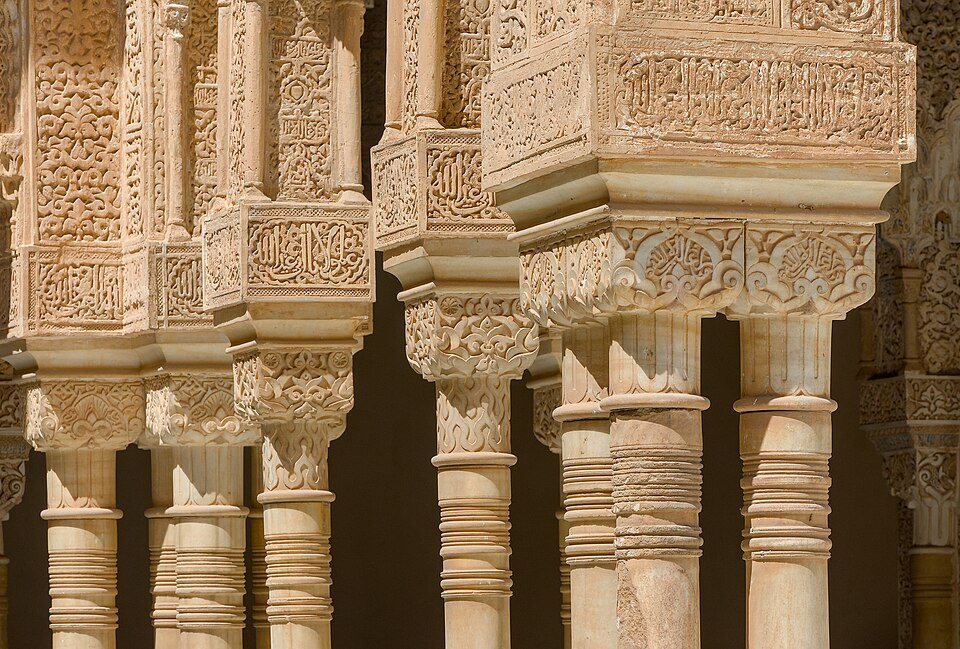
The columns are the detail people remember without being able to explain why. There are 124 of them, arranged in clusters of varying rhythm rather than a strict grid, supporting a filigree of stucco arches so fine that it reads as lace rather than stone from a few feet away. They are not load-bearing in the way a Greek column is load-bearing; the real structural work is done elsewhere, and the columns exist largely to filter light and frame views of the twelve surrounding apartments. Walk the perimeter slowly rather than cutting straight across — the symmetry is only legible from the arcade, not from the open center.
The fountain and its lions
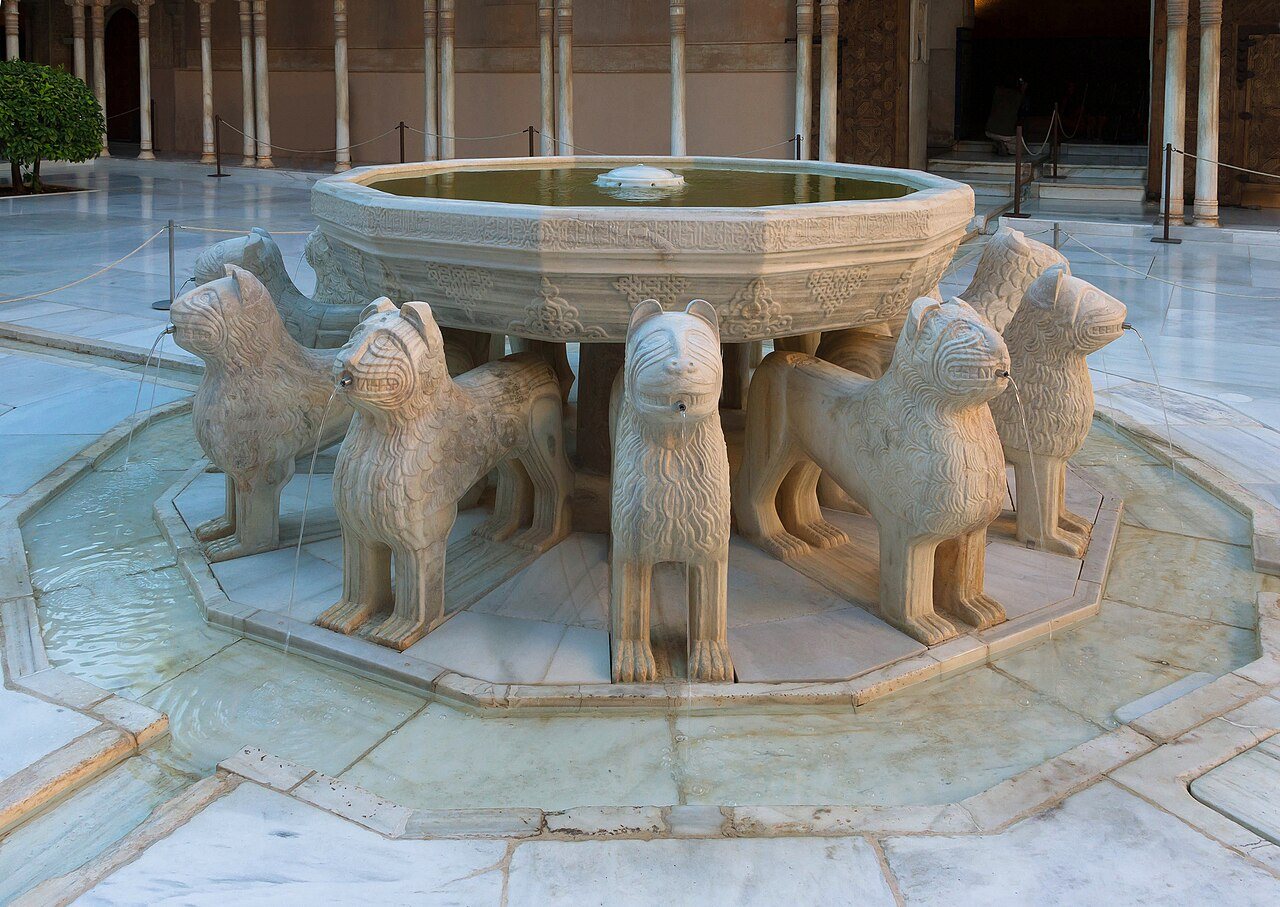
The basin at the center is carried by twelve lions carved from marble, each spouting water from its mouth into a surrounding channel, which then runs out through the four arms of the courtyard into the adjoining halls — the Sala de los Abencerrajes, the Sala de los Reyes, the Sala de Dos Hermanas. The lions themselves are older than the patio around them; scholars generally date their carving to an earlier phase of Nasrid work and believe they were reused here, possibly originally made for a different fountain altogether. Their style is blocky and almost crude compared to the refinement of the stucco overhead, which is part of why historians think they were repurposed rather than commissioned fresh for this spot.
A poem by Ibn Zamrak, the court poet, is carved around the rim of the basin, describing the fountain in verse — comparing the water to ice that never melts and praising the lions as guardians. It's one of a great many inscriptions distributed through the Nasrid Palaces, celebrating the sultan, quoting verse, or repeating the Nasrid motto "wa la ghalib illa Allah" — "there is no victor but God." Exactly how many inscriptions cover the palace walls is a point where sources disagree, so it's safer to say there are a great many rather than commit to a number.
⭐ Look down into the channels, not just at the fountain. The water running through the stone grooves at ankle height is original to the layout and is easy to miss entirely if your eyes go straight to the lions.
Reading the patio in context
It helps to remember what this courtyard was for. This was never a public reception space in the way the Alcazaba's military quarters or the Comares Palace's throne room were. It was domestic, built around the sultan's private apartments, and the four surrounding halls connect directly to bedrooms and living quarters. The restraint of the courtyard — small, enclosed, no sweeping views out — is deliberate. Compare it with the Court of the Myrtles nearby, which is longer, more formal, built for audiences and reflection in its long pool. The Lions court is built for intimacy, and its decoration rewards close, slow looking rather than grand first impressions.
That domestic history took a dramatic turn after 1492. The surrender terms negotiated by Boabdil guaranteed the Muslim population continued rights to property, language, and religious practice. Those guarantees were not honored for long; within a decade the terms had been abandoned, forced conversions began, and the palace itself passed into Christian royal use, later altered under Charles V, whose own Renaissance palace now sits just outside the Nasrid complex (see Palacio de Carlos V). The Court of the Lions is often photographed as though it exists in a vacuum of pure aesthetic pleasure, but it is a space that changed hands under duress, and that history is part of what you're standing in.
Practical notes for visiting
The Court of the Lions is inside the timed-entry portion of the Nasrid Palaces, which means you can't simply wander back for a second look once you've passed through — the route moves in one direction and your ticket admits you for a specific slot. Check the current entry mechanism and timing directly with the Alhambra's official ticketing system before you go, since the process for booking and the specific entry windows are managed centrally and do change.
- ⚠️ Because the courtyard is narrow and the crowd compresses here more than almost anywhere else in the complex, it is not a good spot to linger if you're traveling with anyone prone to feeling boxed in. Move through once, then let the group reconvene in the adjoining Sala de Dos Hermanas, which is larger.
- The lions have undergone restoration work over the decades, including periods when the fountain was run dry for conservation. If you've seen older photographs with no water flowing, that's restoration, not drought.
- Midday sun does the columns no favors — the stucco reads best in the slanting light of early morning or late afternoon entry slots, when the shadows between columns give the patio some depth instead of flattening it.
For a fuller sense of how this courtyard fits into the rest of the Nasrid residence, see Palacios Nazaríes; for the broader historical arc of the dynasty that built it, The Nasrids is the place to start. And if you want to plan the Lions court into a full day at the Alhambra rather than treating it as a single stop, the itineraries section lays out a few sensible routes through the whole site.
In pictures