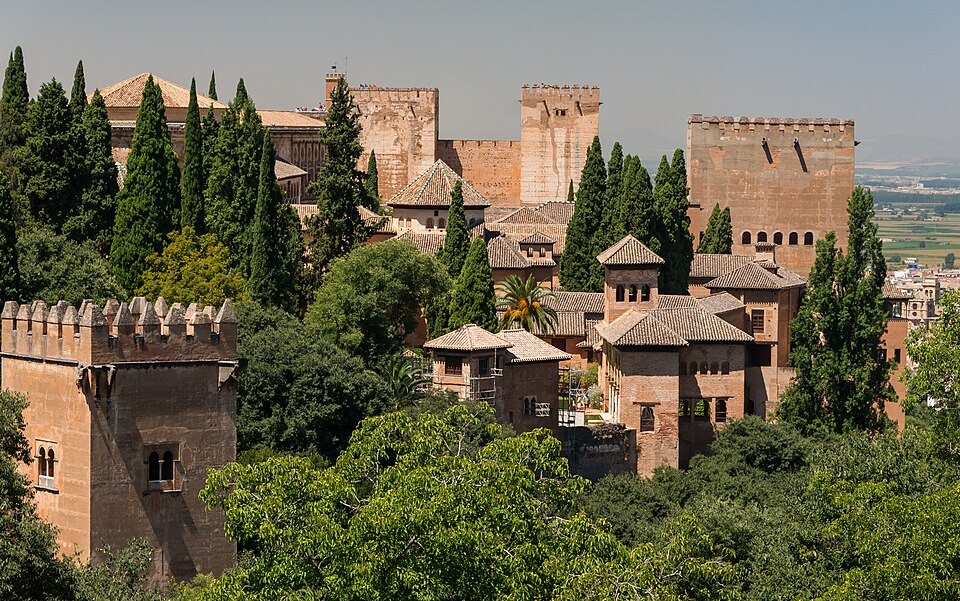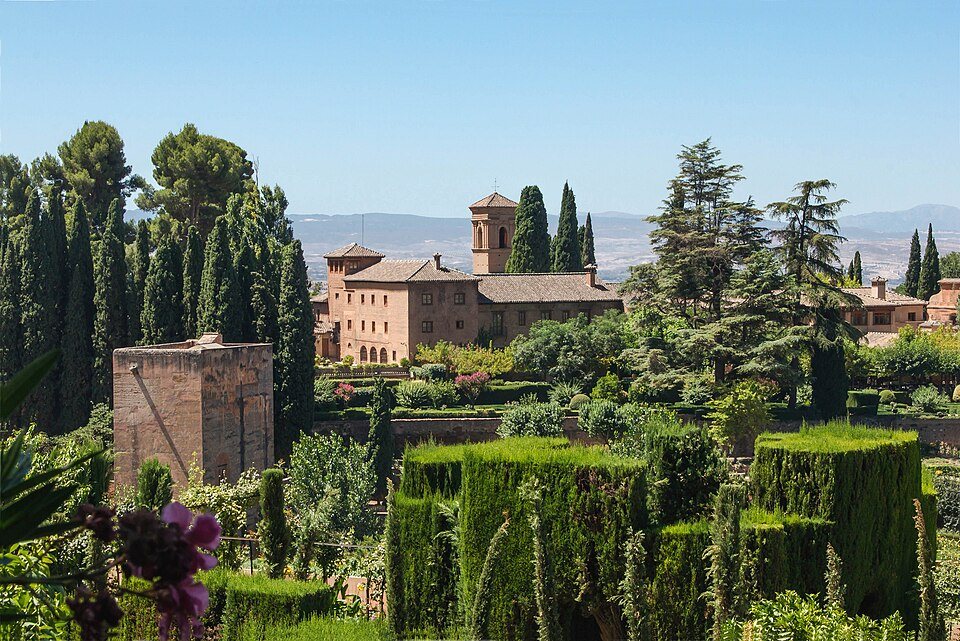
The Generalife sits on the hill facing the Alhambra, separated from the fortress-palace by a ravine, and for centuries it did the one job a royal retreat is supposed to do: give the sultan somewhere to go that wasn't the seat of power. It was an orchard estate and summer residence, not a ceremonial stage like the Palacios Nazaríes, and that difference still shapes how it feels to walk through it. There's less weight here. Less to decode on the walls. More water moving at ankle height and more plants doing the talking.
What the Generalife actually was
The name comes from the Arabic for something like "garden of the architect" or "garden of paradise" — scholars differ on the exact sense — and the function was practical as much as poetic. The Nasrid sultans used it as a working agricultural estate with orchards, vegetable plots, and livestock, as well as a place to retreat from the business conducted across the ravine at the Alhambra. A covered walkway and a path along the hillside connected the two sites so the court could move between them without being seen from the city below. Little of that working estate survives as such — what visitors walk through today is the ornamental core, repeatedly replanted and reshaped by Christian owners, municipal gardeners, and 20th-century restorers, so the planting scheme is layered rather than original. The structure of water channels and courtyards is the part that goes back to the Nasrid period; the roses, the clipped hedges, and a good deal of the cypress are later additions.
That matters for expectations. People sometimes arrive thinking they'll see a 14th-century garden preserved intact, the way the Patio de los Leones preserves its courtyard. What they'll actually see is a garden that has been continuously gardened for six hundred years, which is a different and in some ways more honest thing.
The Patio de la Acequia and what to look at
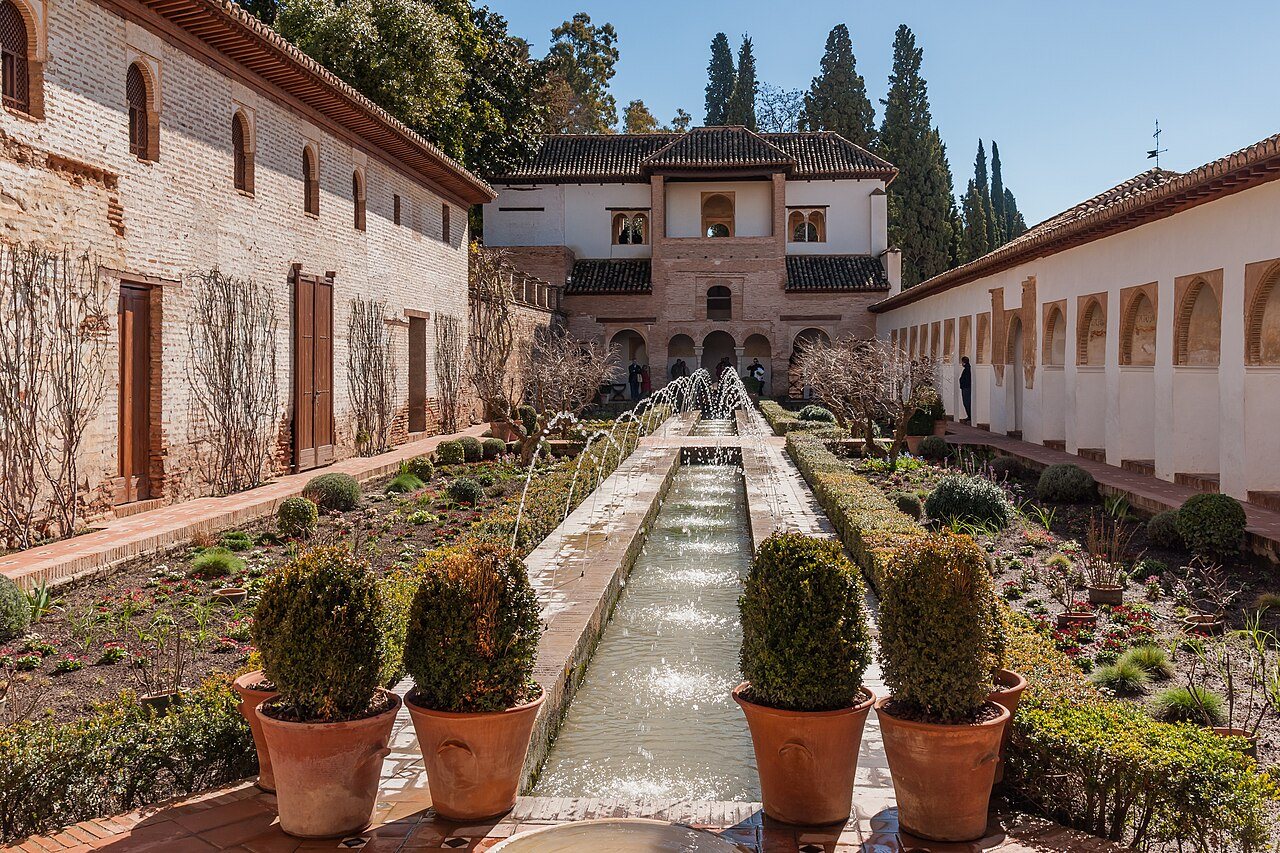
The centerpiece is the Patio de la Acequia, the Court of the Water Channel: a long rectangular courtyard with a canal running its full length, fed by arcing jets of water on either side, flower beds, and a pavilion at each end. It's the single most photographed corner of the Generalife, and for good reason — the symmetry, the sound of the water, and the view back toward the Alhambra's towers over the top of the hedges make it the visual payoff of the whole visit. ⭐ Go slowly around the edges rather than cutting straight across; the water jets and the reflections in the canal are better seen from the side arcades than from the center of the path, where everyone else is standing for a photo.
Past the Patio de la Acequia is the Patio de la Sultana, sometimes called the Patio de los Cipreses, with an old cypress said to be linked to a story about Sultana Zoraya and an alleged affair with a knight of the Abencerrajes family — a tale repeated in guidebooks for generations with no solid documentary basis. It's worth hearing as local lore, not worth repeating as fact.
The upper gardens, reached by a staircase with water running down channels cut into the handrails, lead to a belvedere with views over the Albaicín and the city. This staircase — the Escalera del Agua — is one of the few features that plausibly echoes an original Islamic-period design, since water-cooled stair rails of this kind appear in descriptions of other Nasrid gardens that no longer survive. Whether this exact structure is original fabric or a careful later reconstruction is a point the site's own information varies on, so take the claim of authenticity loosely.
How it fits into a visit, and the mistake people make
The Generalife is included in the general Alhambra admission but is reached by its own entrance and approached along a separate path from the main Alcazaba and palace complex, through what's now a formal garden of clipped hedges and rose beds added long after the Nasrid period. The common mistake is treating it as an afterthought — rushing the palaces because of a slot time, then arriving at the Generalife tired and template-blind, walking through in ten minutes because it "doesn't have the famous rooms." That's backward. The Generalife rewards unhurried walking more than any other part of the Alhambra site, precisely because there's less to read and more to notice: how the sound of water changes as you move between courtyards, how the sightlines are cut to frame the Alhambra's towers rather than hide them.
⚠️ Because entry is governed by a timed slot system tied to your Alhambra ticket, you can't simply wander back later in the day if you rush it the first time — check the admission mechanism and plan your order of visit with the operator's current system in mind rather than assuming you can return.
Shade is uneven. Much of the garden circuit is open to the sun, with relief only in the cypress walks and under the pergolas near the Patio de la Acequia, so a midday visit in summer is a different experience from an early morning one. The open-air theater built into the gardens in the 1950s, used for the Granada International Festival of Music and Dance, is a reminder that the site's life as a garden didn't stop with the Nasrids or with Christian conquest — it's still an active cultural venue, not a museum piece sealed under glass.
Getting there and what to pair it with
Most visitors reach the Generalife as the last stop on an Alhambra visit, after the Palacio de Carlos V and the Nasrid palaces, following the signed path that climbs gently past the Alhambra's eastern wall. The walk itself is pleasant and shaded in parts, with views down into the ravine that separates the two hills. If you're building a fuller day around the Albaicín and the river, the Carrera del Darro and Paseo de los Tristes make a natural continuation on foot, with the Mirador San Nicolás giving you the view back across the ravine toward the gardens and towers you've just walked through — useful for making sense of the relationship between the two hills that the Nasrid court itself depended on. For planning the order of a full Alhambra day, see itineraries and the overview at the Alhambra.
In pictures