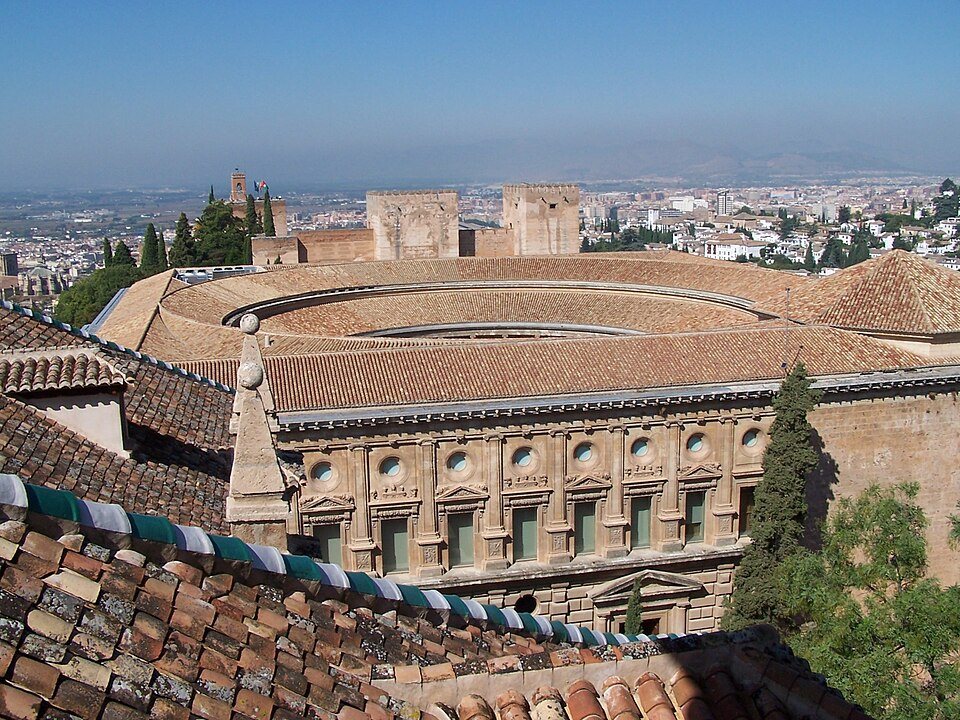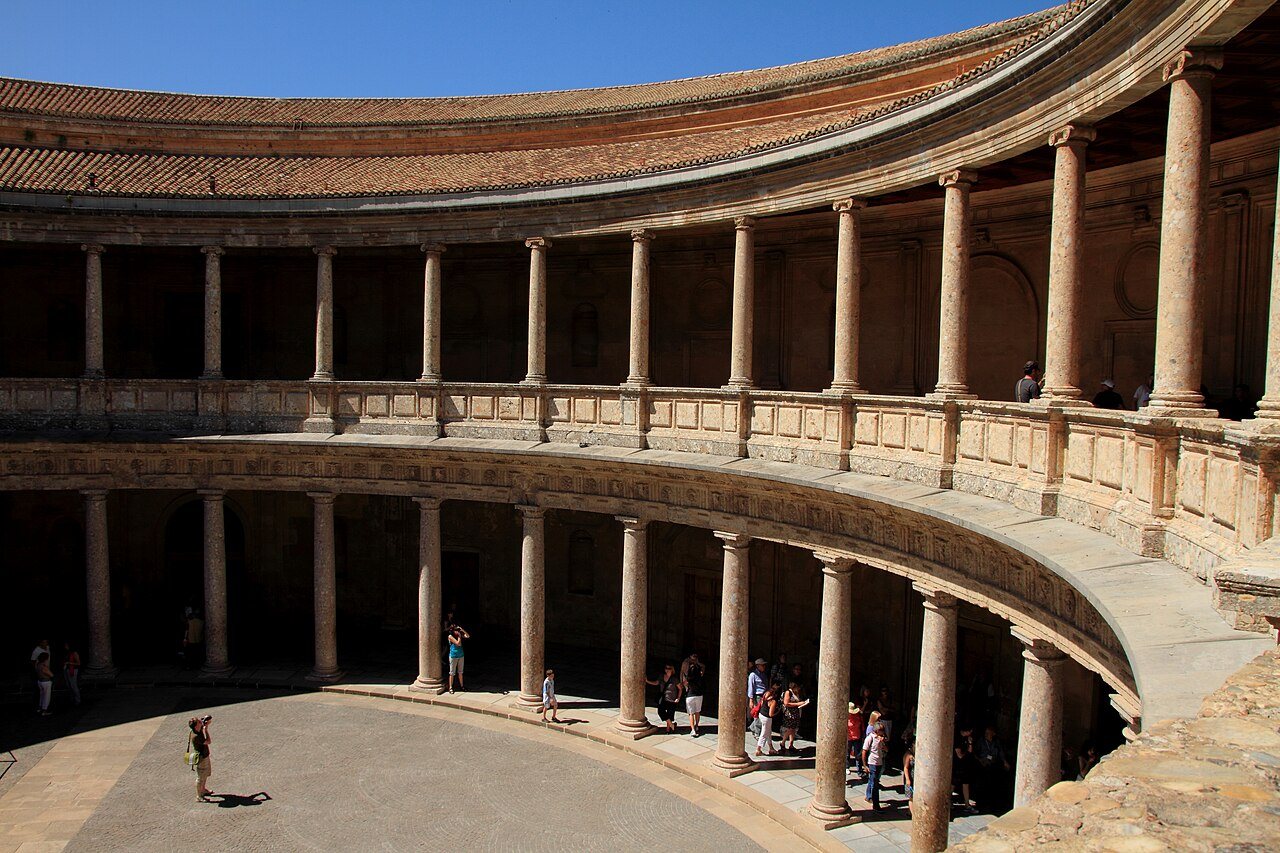
Walk through the Alhambra gates expecting horseshoe arches and carved stucco, and the Palace of Charles V stops people cold. It's a square, two-story block of pale gray stone, built in a style that has nothing to do with the Nasrid palaces next door, and inside it is a perfect circle. A round courtyard, open to the sky, ringed by thirty-two columns, sitting inside a square building like a puzzle piece that doesn't match the box.
That mismatch is the whole point. The building tells you exactly what happened here in the sixteenth century, and it tells you more plainly than any plaque could.
Why a Holy Roman Emperor built a Renaissance palace inside a Muslim fortress
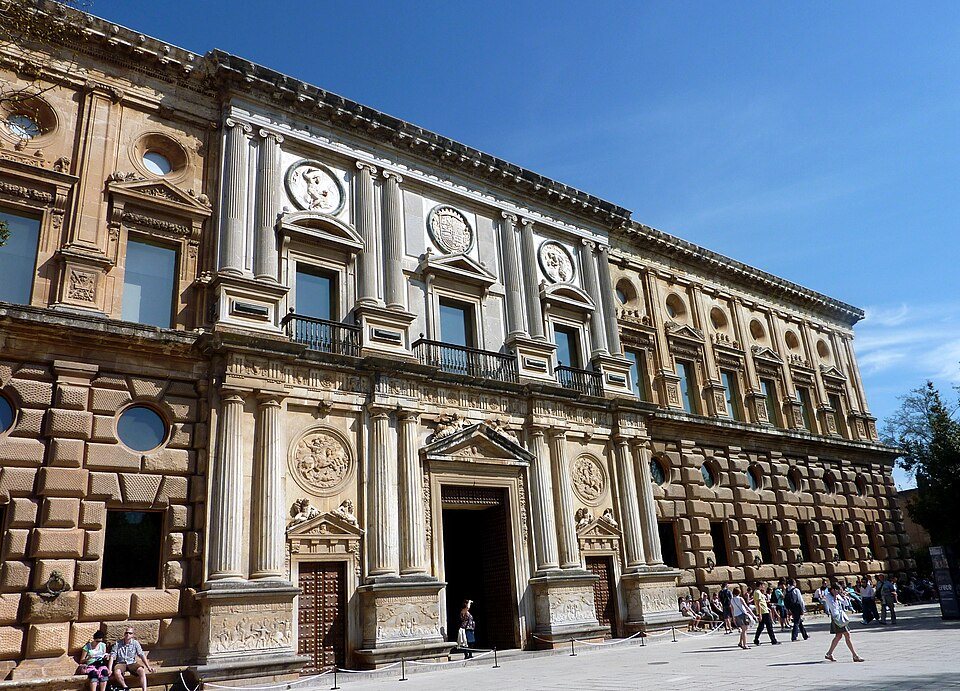
Charles V — Carlos I of Spain, Holy Roman Emperor, grandson of Ferdinand and Isabella — came to Granada in 1526 for his honeymoon with Isabella of Portugal. By then the city had been in Christian hands for a generation; see the Nasrids for how that conquest actually unfolded, and how little the terms of surrender ended up being honored. Charles decided the Alhambra needed a residence worthy of an emperor, something that announced Habsburg power rather than borrowed Nasrid elegance. He had the palace built essentially attached to the Palacios Nazaríes, close enough that visitors today walk from one straight into the other, and the architectural shock is deliberate: stucco lacework and muqarnas ceilings give way, within a few steps, to rusticated stone and Doric columns.
The architect was Pedro Machuca, who had trained in Italy and almost certainly studied under or around Michelangelo's circle. He designed a building unlike anything else in Spain at the time: a pure High Renaissance composition, Italian in its proportions and vocabulary, dropped into an Andalusian hilltop fortress. Construction started in 1527. It was never finished. Work stopped and started for decades, interrupted by funding problems and by the 1568-1571 Morisco rebellion in the Alpujarras, and the roof wasn't added until the twentieth century. For most of its existence, the Palace of Charles V stood as an open shell.
The circle inside the square
The courtyard is the reason to go inside. From the exterior the palace reads as a plain square, its severity broken only by a monumental doorway and a band of relief carving. Step through and the square disappears: you're standing in a circular patio, two stories of colonnade running all the way around, open at the center to a disk of sky. It's one of the few truly circular courtyards from this period anywhere, and the geometry is not an accident — a circle inscribed in a square was a Renaissance ideal of perfect proportion, the kind of diagram Leonardo and Vitruvius both played with. Machuca built it in stone, at full scale, on a hill above Granada.
The lower colonnade uses Doric columns, the upper level Ionic, a classical hierarchy that any educated sixteenth-century visitor would have read instantly. None of it has anything to do with the Nasrid aesthetic a few steps away, and that's worth sitting with for a minute rather than rushing through on the way to the Lions. ⭐ The acoustics in the round courtyard are unusual — a hand clap or a raised voice carries around the curve of the colonnade in a way flat courtyards don't reproduce, and it's used for concerts during the Granada International Festival of Music and Dance.
What's inside now
The ground floor houses the Museum of the Alhambra, with Nasrid-era objects — ceramics, woodwork, metalwork — recovered from the site itself, including pieces connected to the Patio de los Leones lion fountain. The upper floor holds the Fine Arts Museum of Granada, a smaller, less-visited collection of Spanish painting and sculpture from the Granada school, strong on religious imagery from the centuries after the conquest. Neither museum draws the crowds that the Nasrid palaces do, which makes them a reasonable place to catch your breath if you've just come from a timed slot inside the Palacios Nazaríes and need a quieter room for fifteen minutes.
Both museums operate on separate access arrangements from the main Alhambra ticket, with their own days and hours set by the regional government that runs them — check current details directly with the Alhambra ticketing system or the museums themselves before you plan around them, since they are not included automatically with every Alhambra pass.
Finding it, and what to do with it
The Palace of Charles V sits in the upper part of the Alhambra complex, between the Alcazaba and the Nasrid palaces, on the main circulation route most visitors already follow. You don't need to seek it out; you'll walk past its stone facade regardless. The decision is whether to go in.
⚠️ A common mistake is treating the palace as a five-minute photo stop for the circular courtyard and skipping the museums entirely, then realizing on the walk out that you've missed one of the only indoor, uncrowded spaces in the whole complex. If your legs or your patience are giving out after the Generalife gardens and the long approach up from the Albaicín, the museum rooms are air-conditioned, usually quiet, and give you somewhere to sit that isn't a stone bench in direct sun.
It's worth looking at the exterior relief carvings around the main portal too — triumphal, martial imagery of victories and allegories of empire, a world away from the epigraphic poetry carved into the walls of the nearby Alhambra's Nasrid rooms. Reading the two styles side by side, within a hundred meters of each other, says more about the transfer of power in Granada than most museum labels manage. One building speaks in Arabic calligraphy and geometric pattern about paradise and the specific sultan who commissioned it. The other speaks in Latin-derived classical form about a continent-spanning empire. They share a hilltop because history put them there, abruptly, within the same few decades — and the Palace of Charles V, unfinished for most of its life and finally roofed only in the last century, is the physical record of how uneasily that transition sat even with the people who built it.
In pictures