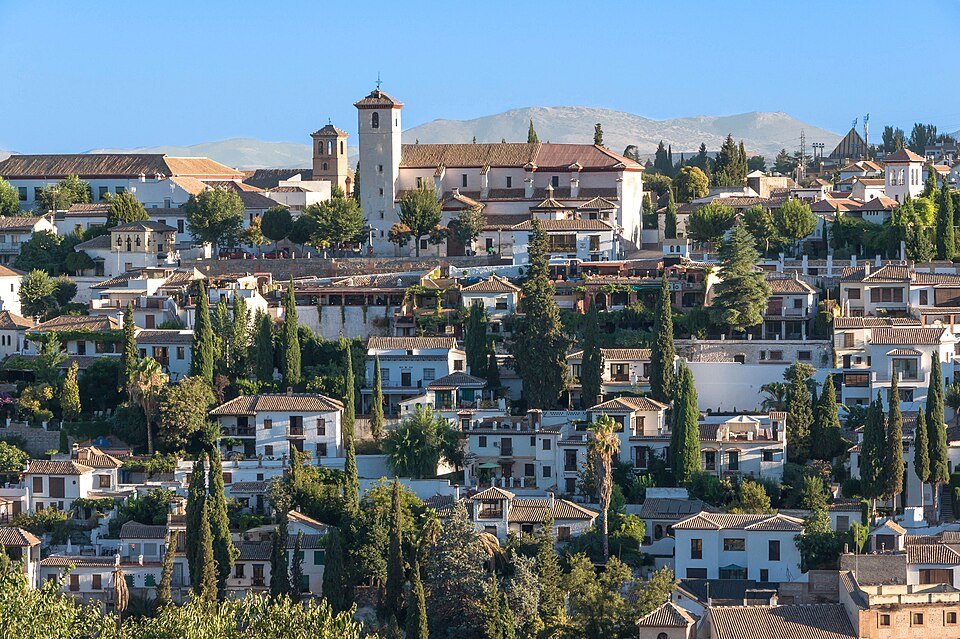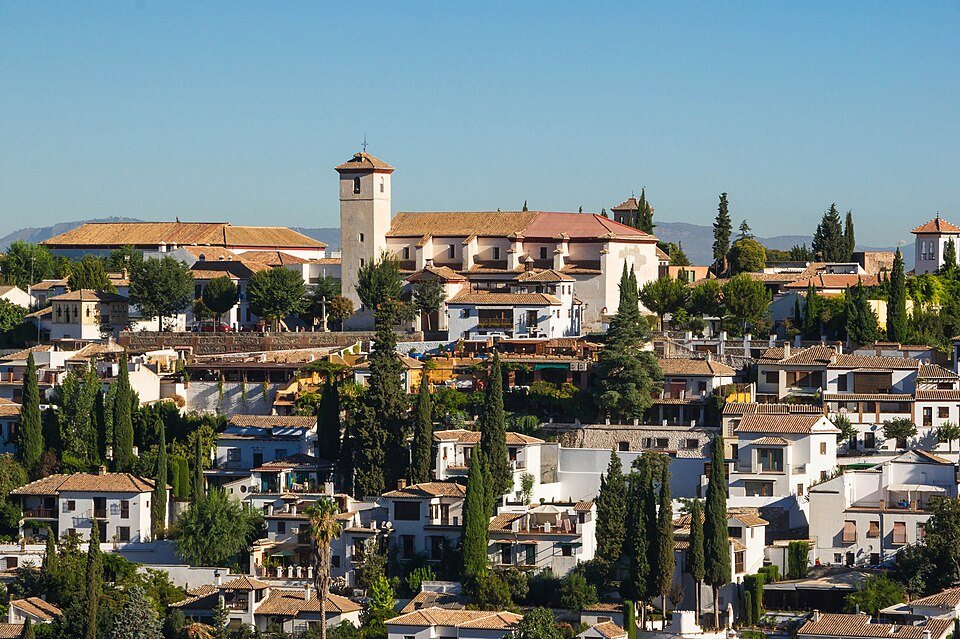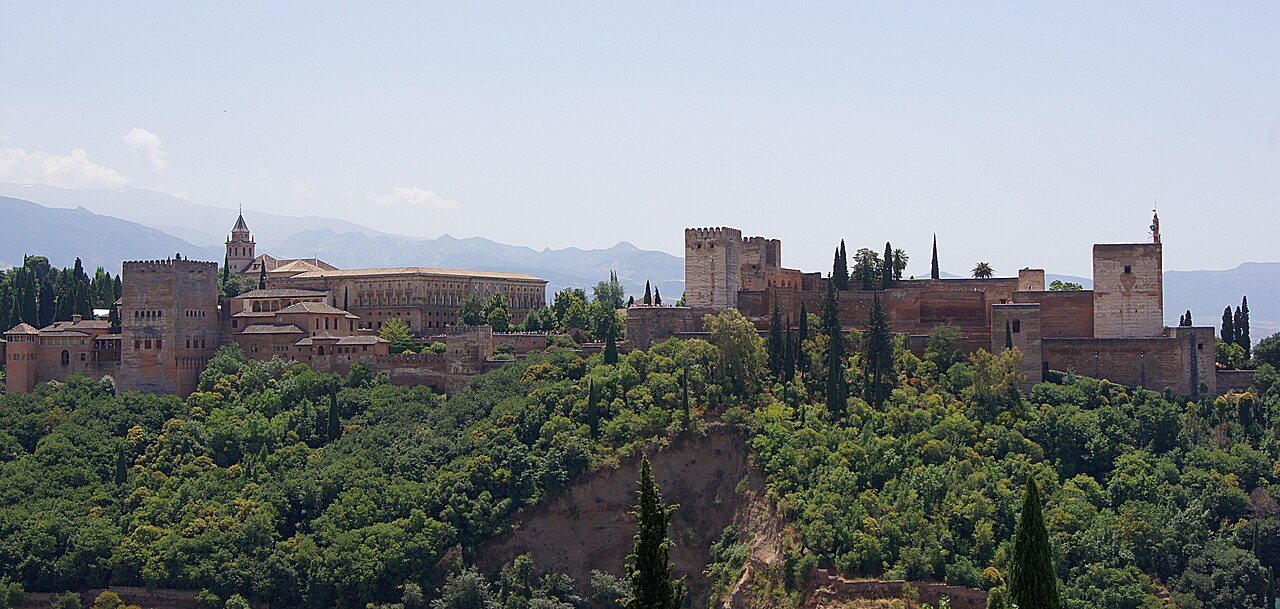
Every photo you've seen of the Alhambra with the Sierra Nevada behind it was almost certainly taken from the Mirador de San Nicolás. It's a small square in front of a plain parish church, and by early evening it can hold a few hundred people, several guitar players, a couple of selling-sunglasses hawkers, and at least one tour group being told, loudly, where to stand. None of that ruins the view. But there's a way to get there that skips most of it, and it has the side benefit of being the more interesting route anyway.
The mistake most visitors make is walking up Calle Elvira or Cuesta de San Gregorio from the Plaza Nueva area, which funnels everyone onto the same two or three streets at the same time, usually about an hour before sunset. It works, but you'll be walking in a slow-moving column of people doing the same thing, and the square itself fills from that direction first. There's a better way in from the river side.
Start at the Darro, not the Plaza Nueva
Walk along Carrera del Darro, the cobbled street that follows the river below the Alhambra's walls, past the Convento de Santa Catalina de Zafra and the small Roman-ish bridge arches. Keep going until the street opens into Paseo de los Tristes, the "walk of the sad ones," named for the funeral processions that used to pass this way to the cemetery above. This stretch alone is worth doing slowly — it's shaded, it runs right along the water, and you get a low, close-up view up at the Alhambra's red walls that you lose once you climb into the Albaicín proper.
From the far end of Paseo de los Tristes, instead of turning onto the main switchback road that buses and taxis use, look for Cuesta del Chapiz climbing away from the square, and then peel off onto one of the smaller lanes — Camino Nuevo de San Nicolás or Callejón de San Cecilio — that cut up through the hillside between whitewashed walls. These are residential streets. You'll pass front doors, laundry lines, cats, the occasional moped squeezing past. It's steep in places, and the paving is uneven old cobble, so this isn't the route for a stroller or for anyone unsteady on an incline — but it's quiet, shaded by walls rather than open to the sun, and it lets you arrive at the mirador from the side rather than walking straight into the crowd facing the view.
Timing matters more than the route
The single biggest factor in whether you enjoy the Mirador de San Nicolás is not which streets you take but what time you arrive. The square is busiest in the thirty to forty-five minutes before sunset, when everyone with a guidebook or a phone has had the same idea at once. If you go an hour earlier than that, you can get a spot at the wall, sit down, and watch the crowd fill in around you rather than having to fight for space. The light on the Alhambra is arguably better anyway in the hour before golden hour proper, when the walls are lit but not yet glowing orange and photographed to death.
⭐ An underused option: go in the morning instead. The square is nearly empty, the air is cooler for the climb, and the Alhambra and Sierra Nevada behind it are often sharper in clear morning light than in the hazier late afternoon. You trade the famous sunset colors for near-total quiet, which for a lot of visitors is the better deal.
⚠️ If you do go for sunset, know that the walk back down afterward is the real bottleneck — several hundred people leaving at once down the same narrow lanes, many of them using phone flashlights on cobblestones that don't need them. Leaving ten minutes before the sun actually disappears, or waiting twenty minutes after, avoids the worst of it.
What you're actually looking at
The view itself is the entire Alhambra complex laid out across the opposite hill: the russet walls of the Alcazaba fortress at the near end, the denser cluster of the Palacios Nazaríes behind it, and the squarer, more obviously European bulk of the Palacio de Carlos V standing out among the older Nasrid roofs. On a clear day the Sierra Nevada rises behind all of it, snow-capped well into spring. It's worth having walked through the Alhambra itself at some point, or planning to, so the view means something beyond "nice castle on a hill" — once you've stood in the Patio de los Leones or walked the Generalife gardens, you can actually place what you're looking at from across the valley.
The square itself is unglamorous: a church facade, a low wall, a few trees, and in summer a scrum of street vendors and performers. It isn't maintained as a polished viewpoint and that's part of its character — it belongs to the neighborhood as much as to visitors, and locals do walk their dogs through it at hours when no tourist is around.
While you're up there
Don't treat the mirador as a there-and-back errand. The Albaicín around it is Granada's old Moorish quarter, a tangle of streets that predates the Reconquista and was largely left alone by the city planners who reshaped other parts of Granada after 1492 — the surrender terms of that year guaranteed the Muslim population's religion and property, though those guarantees were withdrawn within a decade, and the neighborhood's layout is one of the more durable traces of the world that preceded that change. Wandering the Albaicín's back streets after the mirador, with no particular destination, is arguably a better use of an evening than photographing the sunset and leaving.
If you want to extend the walk rather than head straight back down, the Sacromonte quarter continues along the same ridge to the east, known for its cave dwellings and flamenco venues; it's a reasonable continuation if you've still got energy and daylight.
For getting back, the Albaicín's streets are not set up for casual taxi hailing — check getting around for which minibus lines serve the quarter, since the regular city buses don't fit the narrow streets up here. Walking back down the way you came is usually simpler than waiting for transport, just slower than the climb up felt.
In pictures