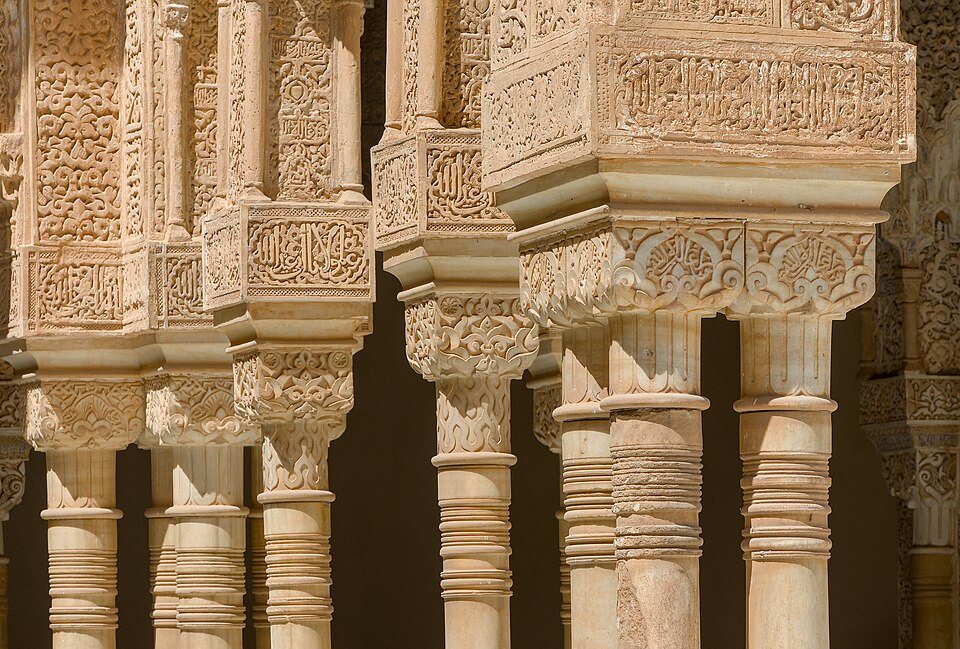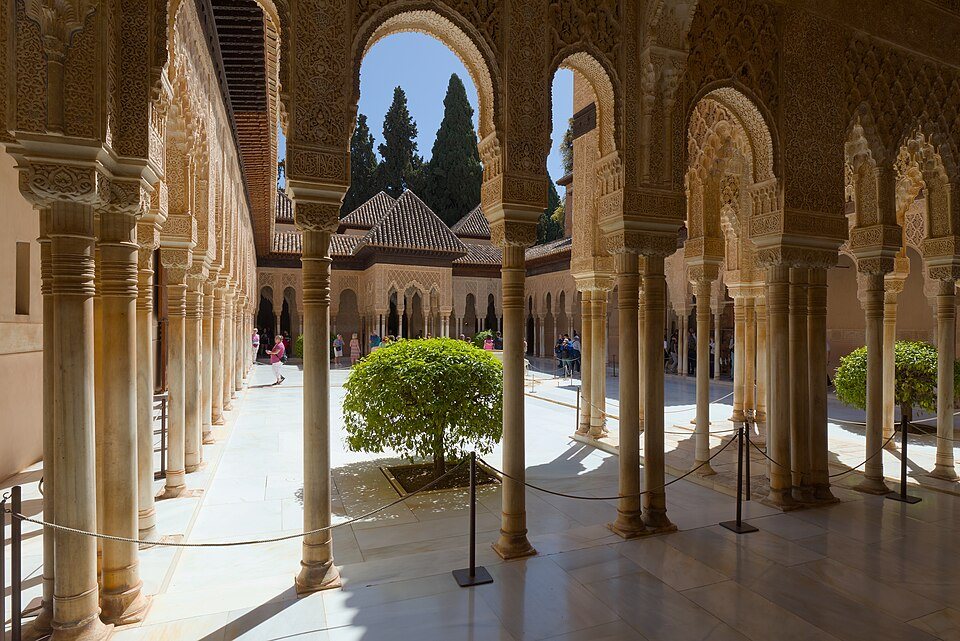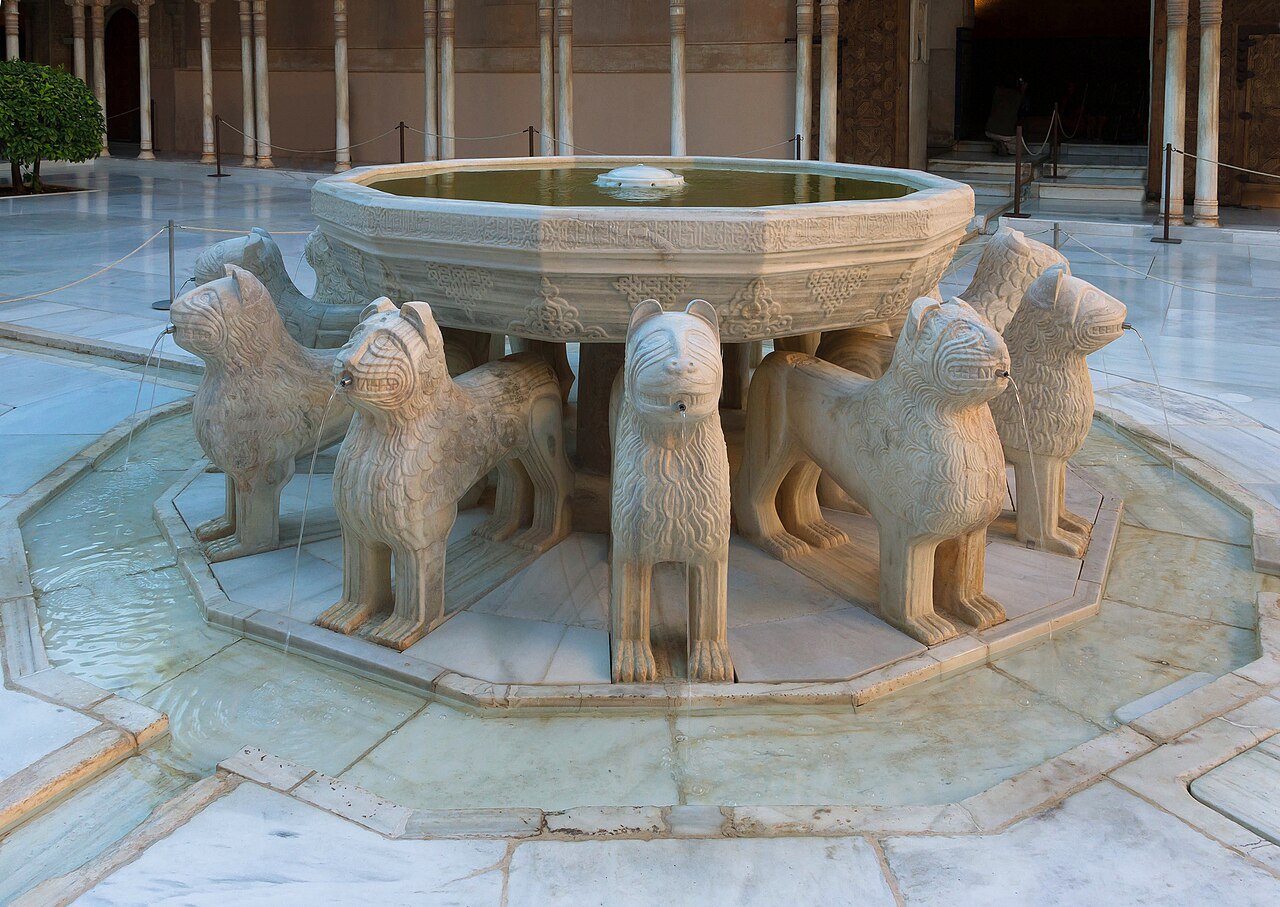
Stand in any room of the Palacios Nazaríes and put a hand near the wall, not on it. What looks like carved stone is almost always carved plaster, built over a timber frame, applied by craftsmen who knew it would never bear the building's weight. The Alhambra's structural walls are rubble and brick, faced with mortar. The astonishing surfaces — the muqarnas ceilings, the epigraphic bands, the star-and-lattice panels — are decoration, applied after the building stood, and decoration is exactly what should have vanished first. Instead it's the marble columns and the carved stucco that visitors travel to see, while sturdier Christian additions nearby, like parts of the Palacio de Carlos V, read to most people as the boring bit.
Plaster is not weakness — it's speed
Nasrid builders worked in a hurry, for reasons that had nothing to do with aesthetics. The Nasrid dynasty that built the palace complex from the 13th century onward ruled the last Muslim kingdom in Iberia, a vassal state paying tribute to Castile for most of its existence, squeezed between a Christian frontier to the north and rival Muslim powers across the strait. Money and time were both short. Carved stone takes masons years. Carved plaster — yeso — takes a skilled team weeks, because it's applied wet over a wooden lath or a rough masonry core and cut while soft, then left to cure. A sultan who might not hold his throne for a decade needed a throne room now, not in 1350 for a war that might be lost by 1360.
The trick worked because plaster and timber, used together and kept dry, are stable for centuries. Wood flexes; masonry cracks. In a region with real seismic activity, the light timber-and-plaster construction of the palaces has absorbed shocks that would have opened fissures in solid stone. The building survived earthquakes, sieges, and four hundred years of Christian reuse not despite being lightweight, but because of it.
What actually destroys it, and what doesn't
The threat was never really time. It was people, water, and one specific army. Napoleonic troops occupying the fortress in 1812 mined sections of the Alcazaba as they withdrew; a former soldier named José García, so the story goes, disabled some of the charges, but towers were lost. Later in the 19th century, the buildings sat semi-abandoned, used as barracks and stables, plaster flaking off walls that no one was paid to maintain. The Romantic-era rediscovery of the Alhambra — Washington Irving lived in rooms here in 1829 while writing about it — probably saved the site by making it fashionable to save, but by then real damage had accumulated.
Water is the enduring enemy. Plaster that stays dry lasts; plaster that gets wet, through a leaking roof or rising damp, delaminates from its backing and falls. Restoration teams work constantly and mostly invisibly, replacing sections of stucco decoration using casts and matching techniques, so that a fair amount of what a visitor touches — carefully, from a distance, since touching isn't allowed — is 19th- or 20th-century restoration sitting beside original 14th-century work. Telling the two apart isn't something a casual visit reveals, and the site doesn't always flag it, which surprises people who expect a museum-label honesty about what's original and what's replaced.
⚠️ Don't assume the surfaces are as tough as they look. The stucco cuts extremely thin in places — a few millimeters — and centuries of restoration have made it more stable, not less fragile to touch, which is why guards intervene fast if anyone leans on a wall.
Reading a wall instead of just admiring it
The bands of Arabic script that wrap almost every room aren't ornamental filler — they're legible text, mostly poetry composed for the specific room by court poets like Ibn Zamrak, plus the repeated Nasrid motto wa la ghalib illa Allah, "there is no victor but God." That phrase was reportedly the response of the dynasty's founder when acclaimed as conqueror; it appears so often across the palace walls that regular visitors start spotting it unprompted. It's worth doing at least once: pick a wall in the Patio de los Leones and try to find where the same phrase repeats. It reframes the decoration as argument, not decor — a dynasty on shaky ground insisting, in writing, on whose ground it actually was.
The muqarnas ceilings — the honeycomb-like stalactite vaulting seen most famously in the Sala de los Abencerrajes and the Sala de las Dos Hermanas — are structurally pointless and that's the point. Nothing about the vault above holds up the roof; it's a separate, suspended decorative shell hung below the real structural ceiling, built from small plaster pieces assembled like a puzzle to fracture light into hundreds of tiny facets. It photographs badly and looks better in person than in almost any picture, because the effect depends on shifting light as the sun moves and as you walk beneath it.
Why the plaster outlasted the politics
The kingdom that built the Alhambra ended formally in January 1492, when Muhammad XII surrendered Granada to Ferdinand and Isabella. The surrender terms, negotiated in advance, promised Muslim residents continued practice of their religion, their own laws, and protection of property. Those terms were not honored for long: forced conversions and expulsions followed within a decade, and by 1526 Charles V had begun building his own Renaissance palace inside the Alhambra walls, a deliberate architectural statement planted next to the building it was replacing in prestige, if not in use. The Nasrid dynasty that commissioned the stucco halls was gone within a generation of finishing them; the plaster stayed.
That's the real oddity worth sitting with on a visit. Empires and treaties and armies came apart faster than a material everyone assumes is fragile. The Generalife gardens next door were rebuilt and replanted repeatedly over the centuries and still trace their original Nasrid layout of courtyards and water channels. The Alhambra didn't survive because anyone in the 14th century built it to last six hundred years — it survived because dry plaster over timber, left alone and occasionally repaired, is more durable than the politics that surrounded it.
⭐ Visit early or late in the day if your ticket window allows a choice — the muqarnas ceilings and pierced screens depend on raking light, and midday sun flattens exactly the detail that makes the plaster worth the trip. For logistics on tickets and timed entry, check the official site directly rather than a guidebook, since access rules change; see the Alhambra overview for how the visit is structured.
In pictures