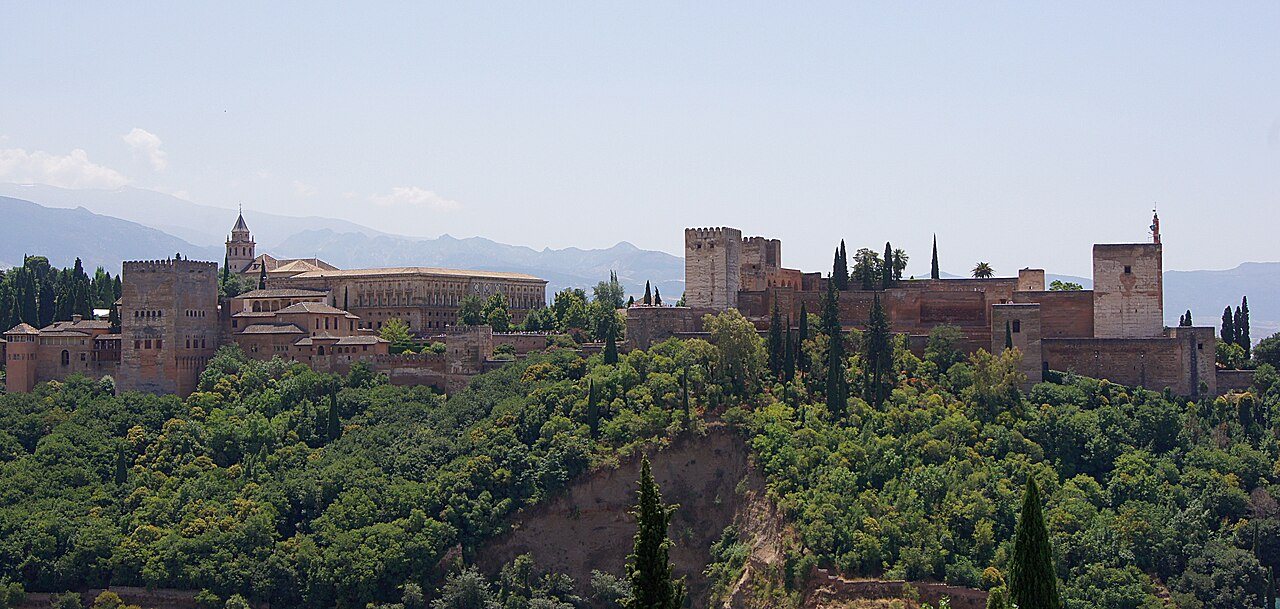
Stand in the Plaza Bib-Rambla with your back to the cathedral and look up. There it is, sitting on its ridge above the rooftops: the Alhambra, red-walled, towered, deliberately placed where everyone below has to keep noticing it. Granada's two halves were built a century and a half apart, by two different civilizations, and the lower city was never a neutral continuation of the upper one. It was an answer. Understanding Granada means reading that argument — the Renaissance grid shouting upward at the hill, and the hill, mostly, winning anyway.
What came before the argument
The terms of surrender in January 1492 guaranteed the Muslim population of Granada continued practice of their religion, their language, their customs, and their property. Those terms were abandoned within a decade — forced conversions, then expulsion, followed. That reversal is the hinge on which everything in this city turns, and it's worth holding in mind before admiring any of the buildings that came after, because most of them were built, directly or indirectly, to make a point about who now owned the place. For the Nasrid period itself, the dynasty that built the hill's palaces over two and a half centuries, see /the-nasrids/.
The Catholic Monarchs and their Habsburg successors inherited a city that already had a perfectly good urban plan — tight, shaded, water-channeled, built for a North African climate by people who understood it. Instead of simply occupying it, they layered a second city on top and beside it, in a style calculated to be legible from any direction as Christian, Roman, imperial. That's the argument: not erasure exactly, but insistence, built in stone where the old city couldn't easily be removed.
The statement buildings of the lower city
Start with the cathedral, raised on the site of the city's main mosque. It is enormous, round-arched, classical where the Alhambra is intricate and enclosed — a building designed to be seen whole from a distance, which is precisely the opposite of Nasrid architectural instinct, where the best rooms reveal themselves only after you've passed through several smaller ones. Attached to it, the Capilla Real holds the tombs of Ferdinand and Isabella themselves, placed in Granada rather than Toledo or Seville specifically because this was the conquest that mattered most to their reputation. It is, among other things, a monument built to outlast an argument by outliving the people having it.
Up on the hill itself, inside the Alhambra's walls, Charles V built something even blunter: a perfect Renaissance circle dropped inside a square, planted in the middle of the Nasrid palace complex as though to correct it. The Palacio de Carlos V was never finished as originally intended and was barely used by the emperor who commissioned it, but its presence is still the loudest single architectural statement in the complex — it says, unmistakably, a different empire lives here now, right next to the Palacios Nazaríes it was built to overshadow.
Down in the old streets, the Alcaicería — once the silk market of Nasrid Granada — survived the centuries in miniature, rebuilt after a fire in the nineteenth century into something closer to a tourist bazaar than a working souk, but its narrow lanes still trace the old commercial logic of the Muslim city, hemmed in now by the Renaissance plazas around it. Bib-Rambla itself, the square where you started, was a Nasrid-era gate plaza that the Christian city kept and repurposed for bullfights, markets, and public executions — continuity of place, discontinuity of use.
The hill talks back
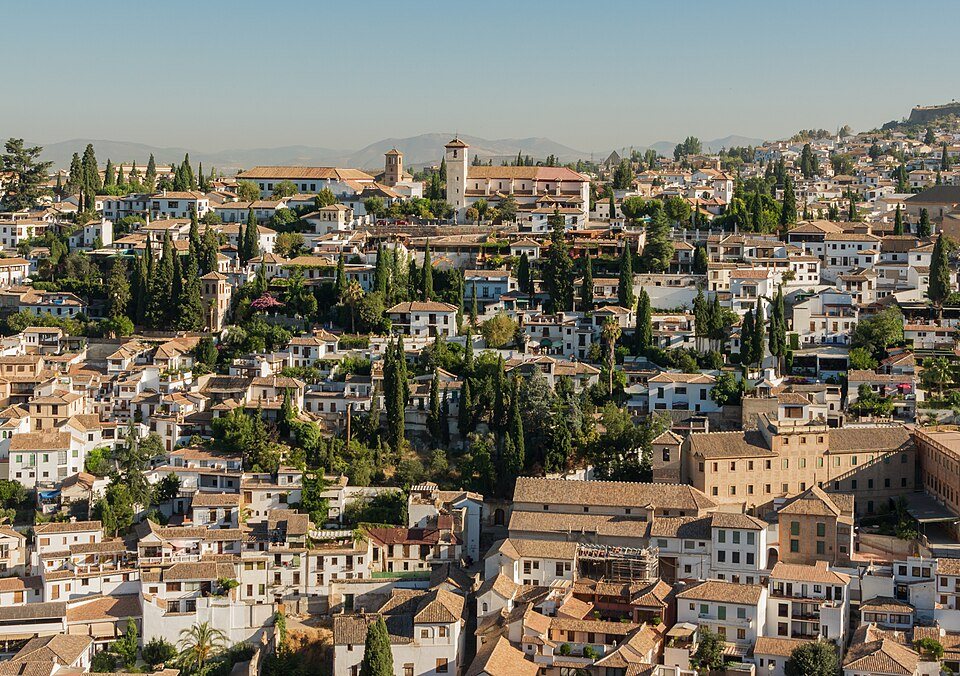
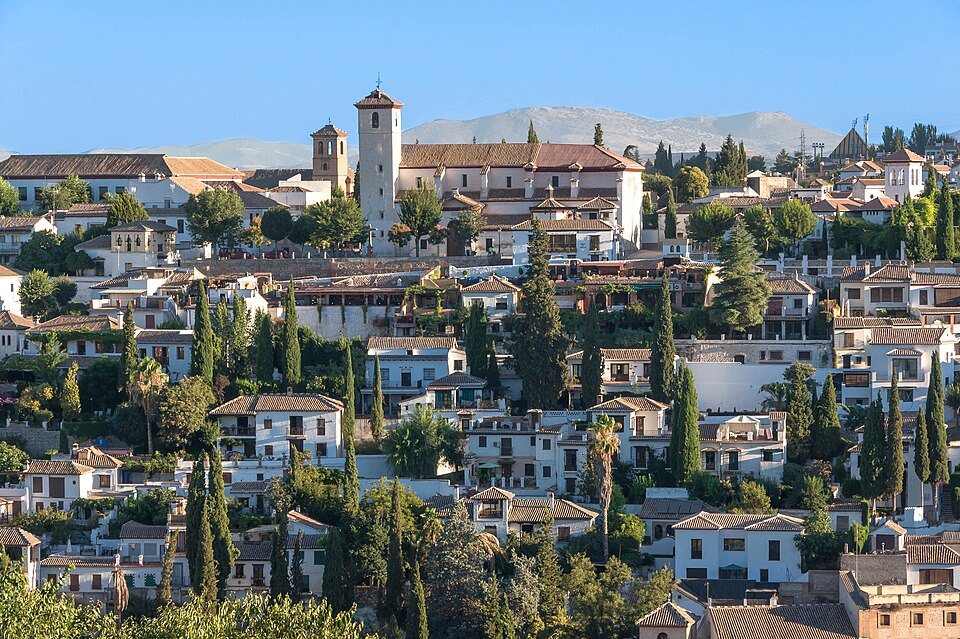
None of this actually silenced the upper city. The Albaicín, the old Muslim quarter across the river gorge from the Alhambra, was never demolished — it survives as a tangle of whitewashed lanes, carmen gardens behind high walls, and cisterns still doing their original job. Walking it, especially along Carrera del Darro up from the river, you're moving through the only large piece of the old city's actual street logic left intact, cobbled and narrow and genuinely confusing on purpose — it was built to be hard for an unfamiliar army, or an unfamiliar visitor, to navigate quickly.
The clearest rebuttal to the Renaissance argument happens at the Mirador de San Nicolás, a small square at the top of the Albaicín that does nothing but frame the Alhambra against the Sierra Nevada. From here the relationship reverses completely: the hill is the whole view, the lower city barely registers, and Charles V's palace just reads as one more red-brown shape among the towers. ⭐ Go at first light rather than sunset if you want the square to yourself — it's one of the most photographed spots in Spain, and the crowds know the hours too.
Further around the hill, Sacromonte adds a third layer that doesn't fit the binary at all: cave dwellings cut into the hillside, settled by Roma communities after 1492, developing their own flamenco tradition independent of both the palace above and the cathedral below. It's a reminder that the "argument with the hill" framing, useful as it is, leaves out the people who weren't invited into either half of it.
How to actually read it on foot
The trap most visitors fall into is treating the Alhambra and the lower city as two separate outings on two separate days, which misses the point of standing in either place. The relationship is the thing worth seeing, and it only reads correctly from certain spots.
- See the hill from below first — Bib-Rambla, the cathedral steps, or the Paseo de los Tristes below the Alhambra's walls — before you go up into it.
- Then see the lower city from above, from the Alhambra's own Alcazaba ramparts or the Generalife's gardens, where the cathedral's bulk looks surprisingly small against the Vega plain beyond it.
- Finish at San Nicolás, where the hill gets the last word regardless of what century you're standing in.
⚠️ None of this requires rushing between timed entries in one afternoon — the Alhambra's ticketing system is separate from the city sights and worth planning around on its own terms; see /the-alhambra/ and /getting-around/ before you build a day around it. For a built itinerary that sequences all of this properly, start at /itineraries/ or go straight to /albaicin-sacromonte/ for the upper-city half of the argument on its own.
In pictures